
General

Dating and Digital Acquisition: What Stage Are We In?

Dating and Digital Acquisition: What Stage Are We In?

Dating and Digital Acquisition: What Stage Are We In?

Zoe Team

4 min read

A financial advisor reviewing a plan with two clients at a table

Key Takeaways

Key Takeaways

  • Financial planning for kids’ education starts early.

  • Digital acquisition has evolved rapidly since the 90s.

  • Building wealth requires intentional, long-term strategy.

Frequently Asked Questions

Frequently Asked Questions

Why is planning for education debt-free important?

High education costs can burden children’s financial futures. Planning early allows for compound growth in dedicated education savings accounts.

How has digital acquisition changed since 1997?

The internet has transformed from a novel communication tool into the primary platform for financial research, shopping, and relationship building.

What is the first step in digital financial planning?

The first step is identifying clear goals, such as saving for college or retirement, and using secure online tools to track your progress and automate savings.

Want Your Kids to Have a Debt-Free Education?

Q: “Where did she find him?”

A: Whispering: “The internet! Can you believe it?”

Back in 1997, two of my cousins were having their annual Holiday gossip session. The hot topic of discussion? How my recently married second cousin had found her husband on something called the internet. Their digital match was discussed in hushed tones and not at all mentioned over dinner, where the topic was considered taboo. The internet was not a place where long term relationships were forged. This is not surprising, considering that during that year only 4% of people found their partner online.

The digital world has allowed us to shift from taboo to typical. It is now commonplace to access a digital marketplace to purchase everything from soap to your iPhone, and there’s data to prove it!

The Digital Marketplace

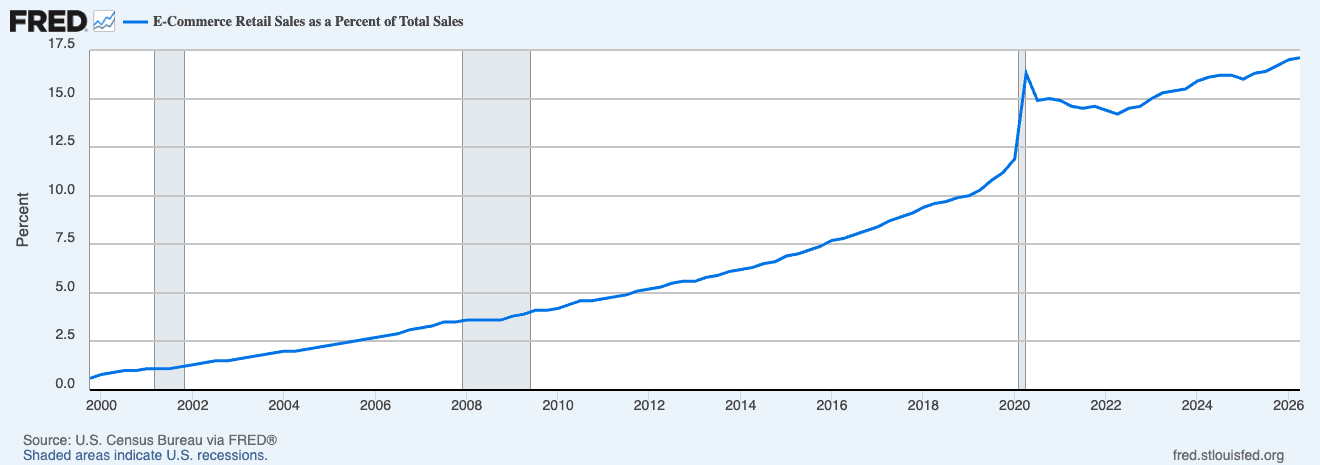
As the chart below shows, in only a decade, the web has almost tripled its share of retail sales from 5% to ~14.3%. That represents about ~$500bln worth of retail goods that are now bought online yearly. To put it in perspective, we’re talking about nearly the same amount as Sweden’s annual GDP. Furthermore, be it the 13.6 million Amazon Prime items delivered a day or the empty storefronts littering suburban landscapes across the United States, it’s clear the digital marketplace is here to stay.

Source: Digital Commerce 360 You’ve likely experienced this trend in your day-to-day and aren’t at all surprised by the prevalence of e-commerce penetration. Yet, the service economy lags behind the “product” economy in the digital world as many question the ability for services to “scale” the same way that products have. After all, in the service industry, the “product” is often a human doing a task. This can make the quality in services more subjective. In addition, some service industries are highly fragmented which delayed the process of coming online. As a result, we have yet to witness this exponential growth occur when it comes to online consumer services. Currently, while the service economy accounts for 69% of national consumer spending, only 7% of services are primarily done digitally.

Offline to Online: Dating

The proliferation of digital services can be seen most acutely in the dating world. Rapidly, specialized courtship websites led to the creation of countless apps designed for meeting and dating new people.

Fast forward to 2017, and as Stanford University reported, a whopping 39% of people now find their significant other via the web. As seen below, the internet went from a non-category 20 years ago to THE medium for people to pair up today.

The dating industry is a $2.5 billion dollar industry, while the North America Wealth Management industry is a $400 billion industry. Thus, there is an evident opportunity within the finance world to use the digital medium to provide specialized services. We have yet to see as rapid digital impact in wealth management; however, we can attribute this to the age of early adopters. Online dating users early-on tended to be in their 20’s and 30’s. Therefore, it’s only reasonable that they would be the first to jump on digital services. We know that dating services aren’t quite as complex or heavily regulated as wealth management. Yet, plenty is being done to close the digital divide in finance consumer services.

Offline to Online: Wealth Management

The age of technology users matures daily. A 50-year-old has been using Google and their iPhone since their early 40’s. They’ve been on the internet since their late 20’s! Because of this, most of their professional lives have been experienced through the digital era, with constantly advancing tools and services that create seamless experiences on and off-line. Therefore, it’s no surprise that at Zoe Financial, we witness thousands of people searching to find their financial advisors via the internet.

Spectrem Group A great example is the Millennial population. As reported by Spectrem Group, 49% of high income millennials have a financial advisor. Understandably, some folks may still feel uneasy about trusting their finances to an advisor they found via the digital space, much like maybe 10 years ago they felt uneasy finding their next date via an app…but the times, they are changing.

The “One”

It’s no longer taboo to find “the One” on the internet, be that your soulmate or your perfect financial advisor. As a number of studies show, the future of complex consumer services in the digital arena is hardly far-off. If a digital finance marketplace is able to consistently provide the highest quality of service for the consumer and frictionless user experience for advisors, then the exponential growth exhibited in the digital dating world could be right around the corner for wealth management.

Want Your Kids to Have a Debt-Free Education?

Q: “Where did she find him?”

A: Whispering: “The internet! Can you believe it?”

Back in 1997, two of my cousins were having their annual Holiday gossip session. The hot topic of discussion? How my recently married second cousin had found her husband on something called the internet. Their digital match was discussed in hushed tones and not at all mentioned over dinner, where the topic was considered taboo. The internet was not a place where long term relationships were forged. This is not surprising, considering that during that year only 4% of people found their partner online.

The digital world has allowed us to shift from taboo to typical. It is now commonplace to access a digital marketplace to purchase everything from soap to your iPhone, and there’s data to prove it!

The Digital Marketplace

As the chart below shows, in only a decade, the web has almost tripled its share of retail sales from 5% to ~14.3%. That represents about ~$500bln worth of retail goods that are now bought online yearly. To put it in perspective, we’re talking about nearly the same amount as Sweden’s annual GDP. Furthermore, be it the 13.6 million Amazon Prime items delivered a day or the empty storefronts littering suburban landscapes across the United States, it’s clear the digital marketplace is here to stay.

Source: Digital Commerce 360 You’ve likely experienced this trend in your day-to-day and aren’t at all surprised by the prevalence of e-commerce penetration. Yet, the service economy lags behind the “product” economy in the digital world as many question the ability for services to “scale” the same way that products have. After all, in the service industry, the “product” is often a human doing a task. This can make the quality in services more subjective. In addition, some service industries are highly fragmented which delayed the process of coming online. As a result, we have yet to witness this exponential growth occur when it comes to online consumer services. Currently, while the service economy accounts for 69% of national consumer spending, only 7% of services are primarily done digitally.

Offline to Online: Dating

The proliferation of digital services can be seen most acutely in the dating world. Rapidly, specialized courtship websites led to the creation of countless apps designed for meeting and dating new people.

Fast forward to 2017, and as Stanford University reported, a whopping 39% of people now find their significant other via the web. As seen below, the internet went from a non-category 20 years ago to THE medium for people to pair up today.

The dating industry is a $2.5 billion dollar industry, while the North America Wealth Management industry is a $400 billion industry. Thus, there is an evident opportunity within the finance world to use the digital medium to provide specialized services. We have yet to see as rapid digital impact in wealth management; however, we can attribute this to the age of early adopters. Online dating users early-on tended to be in their 20’s and 30’s. Therefore, it’s only reasonable that they would be the first to jump on digital services. We know that dating services aren’t quite as complex or heavily regulated as wealth management. Yet, plenty is being done to close the digital divide in finance consumer services.

Offline to Online: Wealth Management

The age of technology users matures daily. A 50-year-old has been using Google and their iPhone since their early 40’s. They’ve been on the internet since their late 20’s! Because of this, most of their professional lives have been experienced through the digital era, with constantly advancing tools and services that create seamless experiences on and off-line. Therefore, it’s no surprise that at Zoe Financial, we witness thousands of people searching to find their financial advisors via the internet.

Spectrem Group A great example is the Millennial population. As reported by Spectrem Group, 49% of high income millennials have a financial advisor. Understandably, some folks may still feel uneasy about trusting their finances to an advisor they found via the digital space, much like maybe 10 years ago they felt uneasy finding their next date via an app…but the times, they are changing.

The “One”

It’s no longer taboo to find “the One” on the internet, be that your soulmate or your perfect financial advisor. As a number of studies show, the future of complex consumer services in the digital arena is hardly far-off. If a digital finance marketplace is able to consistently provide the highest quality of service for the consumer and frictionless user experience for advisors, then the exponential growth exhibited in the digital dating world could be right around the corner for wealth management.

Disclosures: Zoe Financial, Inc. ("Zoe Financial") is an investment adviser registered with the U.S. Securities and Exchange Commission. Registration does not imply a certain level of skill or training. Zoe Financial provides investment advisory services and access to independent registered investment advisers through its platform. The information provided by Zoe Financial is for educational and informational purposes only and should not be construed as personalized investment advice or as an offer to buy or sell any security. All investments involve risk, including possible loss of principal. Past performance is not indicative of future results. Clients should consult with their own financial, tax, or legal professionals before making any investment decisions. The material presented by Zoe Financial is for informational purposes only and is not intended to serve as a substitute for personalized investment advice or as a recommendation or solicitation of any particular security, strategy, or investment product. Material presented has been gathered from sources believed to be reliable, however Adviser cannot guarantee the accuracy or completeness of such information, and certain information presented here may have been condensed or summarized from its original source. Past performance is no guarantee of future results. Zoe Financial does not provide legal or tax advice, and nothing contained in these materials should be taken as legal or tax advice. SEC Registration does not constitute an endorsement of Zoe Financial by the SEC nor does it indicate that Zoe Financial has attained a particular level of skill or ability. The sole purpose of this material is to inform, and it in no way is intended to be an offer or solicitation to purchase or sell any security, other investment or service, or to attract any funds or deposits. Investments mentioned may not be appropriate for all clients. Before making any investment, each investor should carefully consider the risks associated with the investment, as discussed in the applicable offering memorandum, and make a determination based upon their own particular circumstances, that the investment is consistent with their investment objectives and risk tolerance. Lower expenses do not guarantee better investment performance. Certain information contained herein may constitute forward-looking statements. Due to various risks and uncertainties, actual events, results or the performance of a fund may differ materially from those reflected or contemplated in such forward-looking statements.

Disclosure: This page is not investment advice and should not be relied on for such advice or as a substitute for consultation with professional accounting, tax, legal or financial advisors. The observations of industry trends should not be read as recommendations for stocks or sectors.


Investment advisory services are provided by Zoe Financial, Inc. (Zoe Financial), an investment adviser registered with the U.S. Securities and Exchange Commission (SEC). Registration does not imply a certain level of skill or training. Learn more about Zoe Financial on the SEC’s Investment Adviser Public Disclosure website. Brokerage services are provided by Zoe Securities LLC and Apex Clearing Corporation, members of the Financial Industry Regulatory Authority Inc. (FINRA) and Securities Investor Protection Corporation (SIPC). Learn more about Zoe Securities and Apex on FINRA’s BrokerCheck website.

The information in the visuals above is for illustrative purposes only and does not represent an actual user's account, balance, or return. Zoe Financial does not provide tax or legal advice.

Explore the Zoe Wealth Platform with AI

Some of this content may have been generated with the assistance of AI. Please review and sense-check all outputs, as AI tools can occasionally produce incomplete or inaccurate information.
In certain situations, you may be required to disclose that the content was “generated by AI.” Please confirm any specific disclosure or labelling requirements with Compliance.

(646) 680-9244

support@zoefin.com

666 Third Ave, 6th Floor
New York, NY, 10017

Copyright © 2026 Zoe Financial, Inc. | All rights reserved

Disclosure: This page is not investment advice and should not be relied on for such advice or as a substitute for consultation with professional accounting, tax, legal or financial advisors. The observations of industry trends should not be read as recommendations for stocks or sectors.


Investment advisory services are provided by Zoe Financial, Inc. (Zoe Financial), an investment adviser registered with the U.S. Securities and Exchange Commission (SEC). Registration does not imply a certain level of skill or training. Learn more about Zoe Financial on the SEC’s Investment Adviser Public Disclosure website. Brokerage services are provided by Zoe Securities LLC and Apex Clearing Corporation, members of the Financial Industry Regulatory Authority Inc. (FINRA) and Securities Investor Protection Corporation (SIPC). Learn more about Zoe Securities and Apex on FINRA’s BrokerCheck website.

The information in the visuals above is for illustrative purposes only and does not represent an actual user's account, balance, or return. Zoe Financial does not provide tax or legal advice.

Explore the Zoe Wealth Platform with AI

Some of this content may have been generated with the assistance of AI. Please review and sense-check all outputs, as AI tools can occasionally produce incomplete or inaccurate information.
In certain situations, you may be required to disclose that the content was “generated by AI.” Please confirm any specific disclosure or labelling requirements with Compliance.

(646) 680-9244

support@zoefin.com

666 Third Ave, 6th Floor
New York, NY, 10017

Copyright © 2026 Zoe Financial, Inc. | All rights reserved

Disclosure: This page is not investment advice and should not be relied on for such advice or as a substitute for consultation with professional accounting, tax, legal or financial advisors. The observations of industry trends should not be read as recommendations for stocks or sectors.


Investment advisory services are provided by Zoe Financial, Inc. (Zoe Financial), an investment adviser registered with the U.S. Securities and Exchange Commission (SEC). Registration does not imply a certain level of skill or training. Learn more about Zoe Financial on the SEC’s Investment Adviser Public Disclosure website. Brokerage services are provided by Zoe Securities LLC and Apex Clearing Corporation, members of the Financial Industry Regulatory Authority Inc. (FINRA) and Securities Investor Protection Corporation (SIPC). Learn more about Zoe Securities and Apex on FINRA’s BrokerCheck website.

The information in the visuals above is for illustrative purposes only and does not represent an actual user's account, balance, or return. Zoe Financial does not provide tax or legal advice.

Explore the Zoe Wealth Platform with AI

Some of this content may have been generated with the assistance of AI. Please review and sense-check all outputs, as AI tools can occasionally produce incomplete or inaccurate information.
In certain situations, you may be required to disclose that the content was “generated by AI.” Please confirm any specific disclosure or labelling requirements with Compliance.

(646) 680-9244

support@zoefin.com

666 Third Ave, 6th Floor
New York, NY, 10017

Copyright © 2025 Zoe Financial, Inc. | All rights reserved